K Is for Knowledge of the Business: The HAIKU Formula’s Fourth Element
HAIKU Formula Series — Part 4
By Shawn Slusser, Slusser Advisory Group
My GenAI project was nearly killed four times by various functional leaders, including once by the C-suite executive we built it for. They had been told it was redundant with something another team was building. It wasn’t. Months later they tested it themeselves and called it one of their top five strategic priorities.
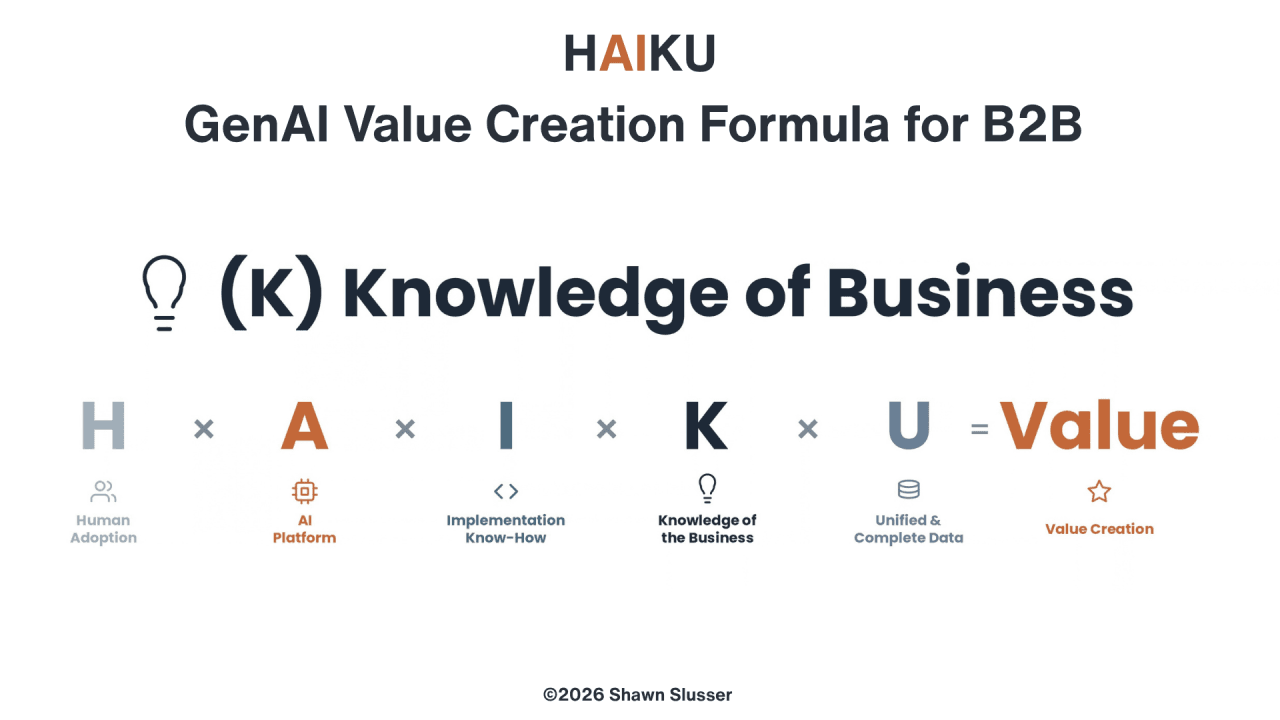
The difference between “redundant” and “top five” was never the technology. It was Knowledge of the Business, the K in my HAIKU formula for GenAI value creation. It’s the element most often underestimated, and most likely to be understaffed on the initiative team.
The Knowledge That Never Gets Fully Transferred
In large B2B companies, the people who truly understand your customers, your business processes, and what “great” looks like are spread across Sales, Marketing, and Product teams. They know exactly what would delight your customers and drive real business value.
But they are fully occupied with their day jobs and therefore do not have time to educate IT and data teams on the business context. And the IT and implementation teams do not have time to learn the business deeply enough to fill that gap on their own. So, the important business knowledge stays exactly where it started: locked in people’s heads, never making it into the AI solution.
Mistake #1: The Business Team Never Gets Pulled In
This is one of the most expensive mistakes in GenAI implementation: a solution that works but does not deliver business value, because the people who knew what value looked like were never truly part of the design process upfront. The problem is that it was designed to the wrong outcome, or to an incomplete picture of the workflow experience the user actually needs.
There is also a direct connection here to the Human Adoption element I wrote about earlier, because experienced business stakeholders are also the people who understand the end user: what their daily workflow looks like, what would genuinely make their job easier, and what “great” feels like from their seat. They are the ones best positioned to define what an improved experience actually looks like.
I’ve watched this go wrong the same way, over and over: either the expert business team never gets pulled into defining the solution at all, or they’re in the room but don’t put in the effort it actually takes. Business stakeholders need to be in the room while the solution is being defined, not brought in afterward to validate something that already exists.
Mistake #2: The Business Team Isn’t Your Best People
There’s a second version of this mistake just as common: the team gets built from whoever has a free time instead of the people your organization already looks to and trusts for performance. It produces the same result as the first: a solution that looks right on paper and fails the people who have to use it.
Your most experienced business experts need to take this responsibility seriously, investing the time and thoughtfulness it takes to actually transfer their knowledge.
Mistake #3: No Executive Has Skin in the Game
It’s not enough to assign a business expert team. There also needs to be an executive sponsor from the business, typically a functional leader such as a VP or C-suite executive, who personally benefits from the value this solution is meant to create. I’ve seen plenty of digitalization initiatives launch without anyone truly in that seat, and the pattern is always the same: nobody is personally accountable if it fails, so nobody fights for it when priorities compete. Not a sponsor in name only. Someone whose own numbers move if the initiative works, and who has a real stake in whether it does.
This person is ultimately accountable for confirming that the incremental business value actually gets delivered, not just that the solution gets built. That accountability starts with documenting the specific business outcome the initiative is meant to produce and how it will be measured. Without that definition, there is nothing concrete to hold anyone accountable to.
Mistake #4: Failing to Assign a Bridge Leader
To help the executive with day-to-day implementation, they need someone positioned between their vision and the project execution, translating one into the other every day the initiative is in motion. The role I have seen work for this is a committed “Bridge Leader” focused on making sure that the implementation actually generates the expected business value and does not become just another tool that gets launched.
This is someone who can bridge business intent, data semantics, technology trade-offs, and prioritized implementation steps. They can speak both business and technology languages. They work within the initiative to keep all five element owners aligned and moving toward the same business value outcome.
This role may look at first like a project manager, and that’s exactly the mistake I’ve seen sink these initiatives: an IT project manager without genuine Bridge Leader capability gets put in charge, and has no way to detect when the project is drifting away from the business value it was supposed to create. A project manager is focused on finishing the project, not owning the business outcome. The Bridge Leader is accountable for whether the solution actually delivers value, not just whether it gets delivered.
Why This Role Is Harder to Fill Than It Sounds
The Bridge Leader carries significant and complex responsibilities. They need enough hands-on business experience to earn trust from business stakeholders and technical teams at the same time, and to keep both sides moving together even when priorities compete.
They also need the authority to question implementation decisions when the value is at risk, and to make agile adjustments the moment they see business value slipping.
They need to understand the vision clearly enough to hold it constant while breaking it down into specific, actionable implementation steps for the AI solution. This is what I call a Bridge Leader skill set and these people can be rare in an organization. I wrote about what Bridge Leaders do in this article to help you identify the kind of people you need to find for this role
Three Steps to Avoid These Mistakes
Before your next GenAI initiative begins, three things need to be in place to avoid the mistakes above.
First, select the expert business stakeholders whose knowledge your initiative depends on, and confirm they have dedicated, protected time to contribute.
Second, name an executive business leader who will genuinely benefit from the result and who is ultimately accountable for whether the value gets delivered. That same leader should document the business value you intend to capture and how it will be measured, before development starts.
Third, find a dedicated and empowered Bridge Leader, and have them report to the executive business leader. Someone who can hold the business vision and the technical implementation in the same hand, and continuously monitor that business value is being delivered. Remember, they are a rare find in your organization so look hard.
Don’t let an underinvestment in business knowledge become the “0” factor wiping out your value in the HAIKU formula. If this framework is raising questions about where your initiative stands, schedule a call with me. I'm happy to share my thoughts and experiences because I know leadership can feel lonely.